
Best Gifts for Toddlers That Aren’t Junk (by Developmental Stage)

Walk through any toddler’s playroom a year after a couple of birthdays and you can usually spot the graveyard: the light-up plastic thing that only does one trick, the toy that sang the same song until someone hid the batteries, the gadget that got thirty seconds of attention and a lifetime on the shelf. “Gifts that aren’t junk” is really a wish for two things at once — toys that last, and toys that actually do something for the child. The good news is that those tend to be the same toys, and they’re rarely the flashy ones. Here’s how to choose them, organized by the stage your toddler is actually in.
What “developmental” really means (and what to ignore)
The toy aisle is full of boxes promising to build your baby’s brain, and most of that is marketing. The genuinely useful guidance from the American Academy of Pediatrics is refreshingly simple: the best toys are the ones that are mostly open-ended and invite a child to do the work. A good rule of thumb is that the best playthings are about ninety percent child and ten percent toy — a set of blocks becomes a tower, a zoo, a road, and a wall over the course of one afternoon, while a button-activated toy does its one thing and waits.
That’s also why pediatricians are lukewarm on screen-based and heavily electronic toys for this age. A tablet that names colors can’t read your toddler’s face, wait for them to point, or answer a babbled question the way you can, and that back-and-forth is what actually builds language. None of this means you need to spend a fortune; the AAP is explicit that high quality doesn’t mean expensive. A wooden stacking toy and a stack of library books will outperform most of the talking plastic on the shelf.
One note before the lists: ages on toys are guidelines, and children hit milestones across a wide and totally normal range. Use the stages below as a rough map, not a deadline, and always follow the age grade printed on the box — it exists for safety, not just suggestion.
Around 12 to 18 months: the new walker

Somewhere in here your baby becomes a slightly alarming toddler — pulling up, cruising the coffee table, then letting go and lurching across the room. They’re learning that their actions cause effects, they’re starting to stack and drop and fit things together, and they love anything that responds to what they do.
This is the age for classic cause-and-effect and gross-motor toys. A simple ring stacker like the timeless Fisher-Price Rock-a-Stack, or a wooden version from PlanToys, gives little hands grasping and ordering practice. Shape sorters and ball-drop toys deliver that satisfying “I did that” payoff. A push toy steadies brand-new walkers, and chunky board books — the indestructible kind, or anything by Sandra Boynton — hold up to chewing while you build the reading habit early. For first art, skip standard crayons and reach for something made for this age, like chunky beeswax crayons, since everything is still going in the mouth.
Around 18 to 24 months: the imitator
Now they want to do what you do. They’ll “sweep” with a toy broom, feed a stuffed animal, push a toy lawnmower around the yard behind you. Language is starting to take off, pretend play is flickering to life, and their hands are getting precise enough for real building and puzzles.
LEGO Duplo is the workhorse here — the big bricks are too large to choke on and grow with the child for years. Knob puzzles from Melissa & Doug build fine motor skills and vocabulary at the same time (“that’s the duck, that’s the tractor”). A pull wagon or a push cart satisfies the urge to haul their belongings from room to room. And this is where pretend play earns its first real gift: a few wooden pots, some play food, the beginnings of a kitchen. If you want toys chosen specifically for skill-building at this stage, our roundup of the best educational toys for toddlers goes deeper on the open-ended options worth the shelf space.
Two-year-olds: pretend play takes over
The two-year-old runs, climbs, kicks a ball, and — most importantly for gift-giving — narrates an entire imaginary world. They’ll put the toy food on a plate, serve it to you, and be genuinely offended if you don’t pretend to eat it. This is prime time for role-play and for building that takes a little more dexterity.
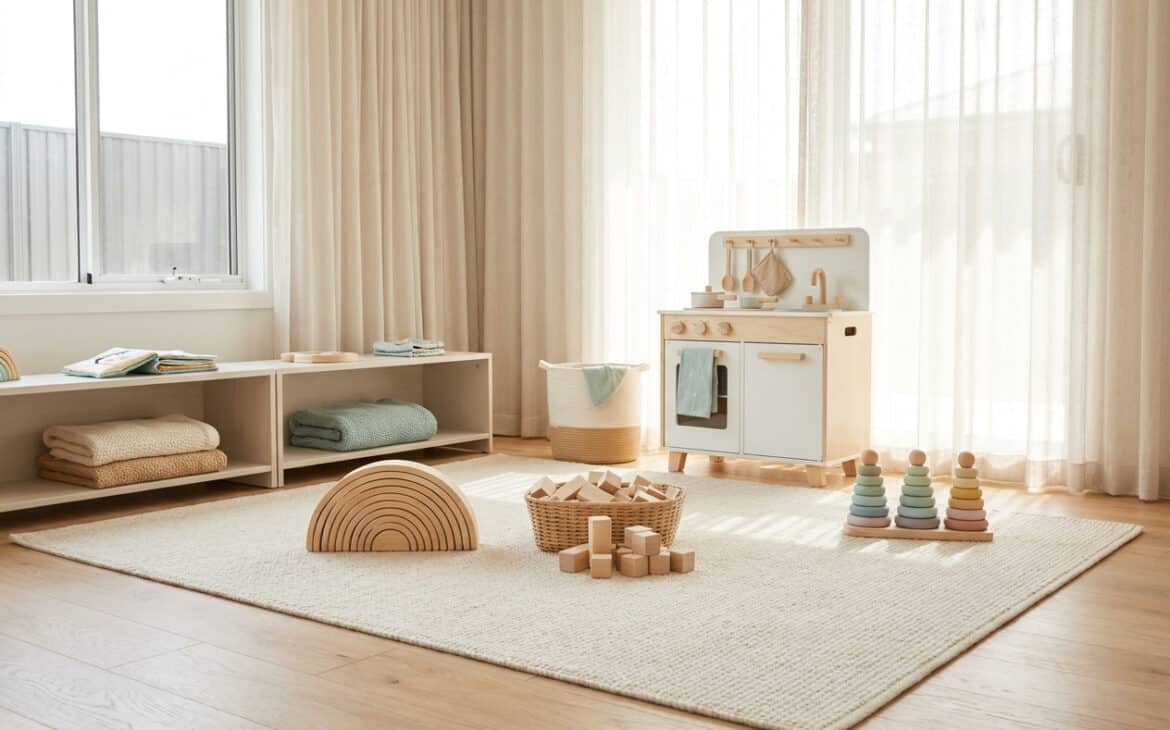
A wooden play kitchen is close to a sure thing at this age, as is a first baby doll with a little care set — nurturing play is for every kid, regardless of gender, and it builds empathy and language. Cutting-food sets with the satisfying Velcro “slice” combine pretend cooking with fine motor work. A balance bike, like the low-seated Strider, is a fantastic two-ish gift that many kids grow into around now and ride for years. One toy to flag carefully: Magna-Tiles are extraordinary open-ended builders, but they’re rated for ages three and up because of the magnets inside. A swallowed magnet is a genuine medical emergency, so for a two-year-old, either buy them as the gift they grow into or only bring them out with close supervision.
Three-year-olds: the storyteller and builder
By three, pretend play has a plot — “you be the doctor and I’m sick” — and construction gets ambitious. Attention spans stretch, puzzles get real, and a three-year-old can start to handle taking turns, which opens up a whole new category of gift.
This is the age where Magna-Tiles are squarely appropriate and tend to become the most-played-with thing in the house. Themed Duplo and Mega Bloks sets feed the storytelling-through-building urge. Play-Doh and washable crayons or markers develop the hand strength and grip that later become handwriting. Dress-up and role-play kits — a doctor set, a toy tool bench — give the narratives props. Floor puzzles in the twenty-four to forty-eight piece range offer real, sustained problem-solving. And three is the sweet spot for a first cooperative board game like Hoot Owl Hoot! or Hi Ho! Cherry-O, where the simple act of taking turns is the whole developmental point.
The brands worth knowing

A handful of makers come up again and again because they get the open-ended, well-built, lights-and-noise-free formula right. For wood, look at PlanToys, Hape, and Grimm’s — the Grimm’s rainbow stacker is the iconic example of a single toy a child reinvents a hundred ways. Melissa & Doug is the reliable, affordable backbone of most toddler toy boxes. For building, Duplo and Magna-Tiles are the standouts at their respective ages. And if you genuinely don’t know what to buy, a Lovevery Play Kit is a thoughtful, Montessori-informed subscription matched to your child’s stage; just know it’s a premium price, running around a hundred and twenty dollars per kit, so it’s more of a special gift than a stocking stuffer.
What to skip
The toys that end up in the graveyard tend to share a profile. Single-function, battery-operated toys — press the button, it does the thing — put the toy in charge and the child on the sidelines, which is backwards from how good play works. Very loud toys held close to little ears are worth avoiding on hearing grounds alone. Screen and tablet toys don’t deliver what real interaction does and are discouraged for this age. And two safety points deserve to be non-negotiable: under age three, steer clear of anything with small parts that fit in a toddler’s mouth, and treat button batteries and high-powered magnets as serious hazards — both can cause severe internal injury if swallowed, which is exactly why Magna-Tiles carry that 3+ grade.
The best “gifts” sometimes aren’t toys
For the toddler who already has every toy, the most welcome present is often something that isn’t one. A membership to the zoo, aquarium, or children’s museum buys a year of outings and zero clutter. A package of swim lessons, a magazine subscription in their name, or a stack of art supplies that gets gleefully used up all make wonderful gifts. Books are never the wrong answer. And there’s a real case for the thoughtful practical gift — a personalized name puzzle or keepsake (we have a whole guide to personalized gifts for toddlers), or something they’ll genuinely wear and use, the kind of pieces in our roundup of toddler clothing gift ideas. None of it lights up or sings, and that’s rather the point.
Frequently Asked Questions
Are wooden toys really better than plastic?
Not because of the material itself. Wooden toys tend to be simpler and more open-ended, which is what actually matters, and they’re often more durable and free of lights and sounds. But a well-designed open-ended plastic toy like Duplo or Magna-Tiles is excellent too. Judge the toy by how much it leaves to the child’s imagination, not by what it’s made of.
Are subscription kits like Lovevery worth it?
They’re genuinely well-designed and stage-matched, which takes the guesswork out of choosing, and that makes them a great gift. The trade-off is cost — around a hundred and twenty dollars a kit. If budget is tight, you can recreate most of the benefit with a few individual wooden toys and a library card.
When can my child safely play with Magna-Tiles?
The manufacturer grades them for ages three and up because of the magnets, and a swallowed magnet is a true emergency. Under three, only with constant supervision, or simply give them as a gift the child grows into. From three on, they’re one of the best open-ended toys you can buy.
My toddler ignores the toy and plays with the box. Should I worry?
Not at all — that’s exactly the kind of open-ended, self-directed play experts hope for. A box, a set of containers, or a pile of pots invites more imagination than most toys do. Lean into it.
How many toys does a toddler actually need?
Fewer than the average playroom holds. A small, rotated set tends to hold attention better than a mountain of options, which can overwhelm and fragment play. Keeping most toys put away and cycling a handful at a time keeps them feeling new.
Do electronic “educational” toys really teach letters and words?
Be skeptical of the claims. A talking toy can’t match the language learning that comes from a caregiver reading a book or narrating play, because real conversation is responsive and a recording isn’t. For building vocabulary, a board book and ten minutes of your attention beat the tablet every time.