Rainy Day Indoor Activities for Kids (No Screens)

There’s a particular flavor of long when it’s raining, the kids are home, and someone has already asked to watch something for the third time before ten in the morning. You don’t need fifty Pinterest projects and a craft-store run. You need a handful of ideas you can start in the next five minutes with what’s already in the house — some to burn off the cooped-up energy, some to bring everyone back down before the meltdowns start. That’s how this list is built: by what kind of day it is and how old your kids are, not by what supplies you wish you had.
When you need to burn off energy
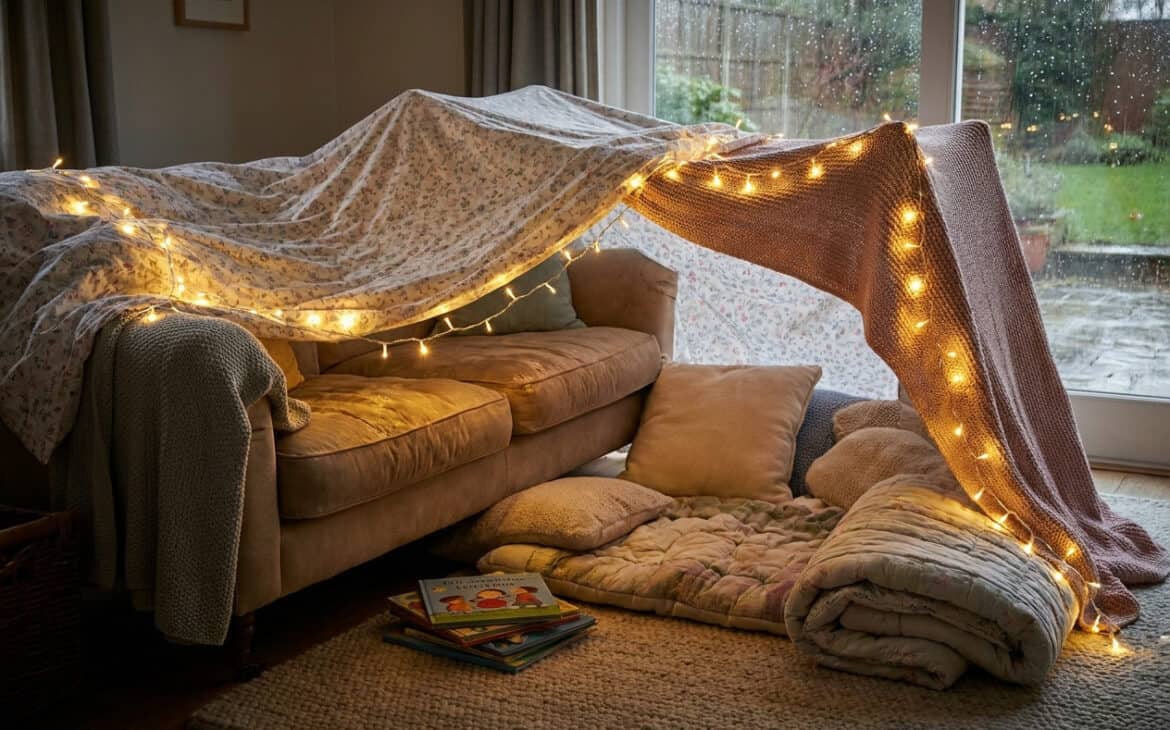
A rainy day with no physical outlet is how living rooms turn feral. The fastest fix is to turn the house itself into a course. Build an indoor obstacle course — crawl under the dining chairs, hop across couch-cushion stepping stones, the floor is lava between them — and you’ve bought a surprising amount of time, especially with preschoolers and up. Painter’s tape is the secret weapon here: a hopscotch grid down the hallway, a “balance beam” line to walk heel-to-toe, jumping targets stuck to the floor.
For something that works from toddlers to big kids, balloon volleyball is hard to beat — one balloon, the rule that it can’t touch the floor, and you can add constraints (“elbows only”) as it goes. Freeze dance burns energy and ends in giggles. A sock “snowball” fight is gloriously loud and almost zero mess to clean up. And animal-walk relays — bear crawls, crab walks, frog jumps from one end of the room to the other — need nothing at all and wear kids out fast.
Forts, pretend, and the long game
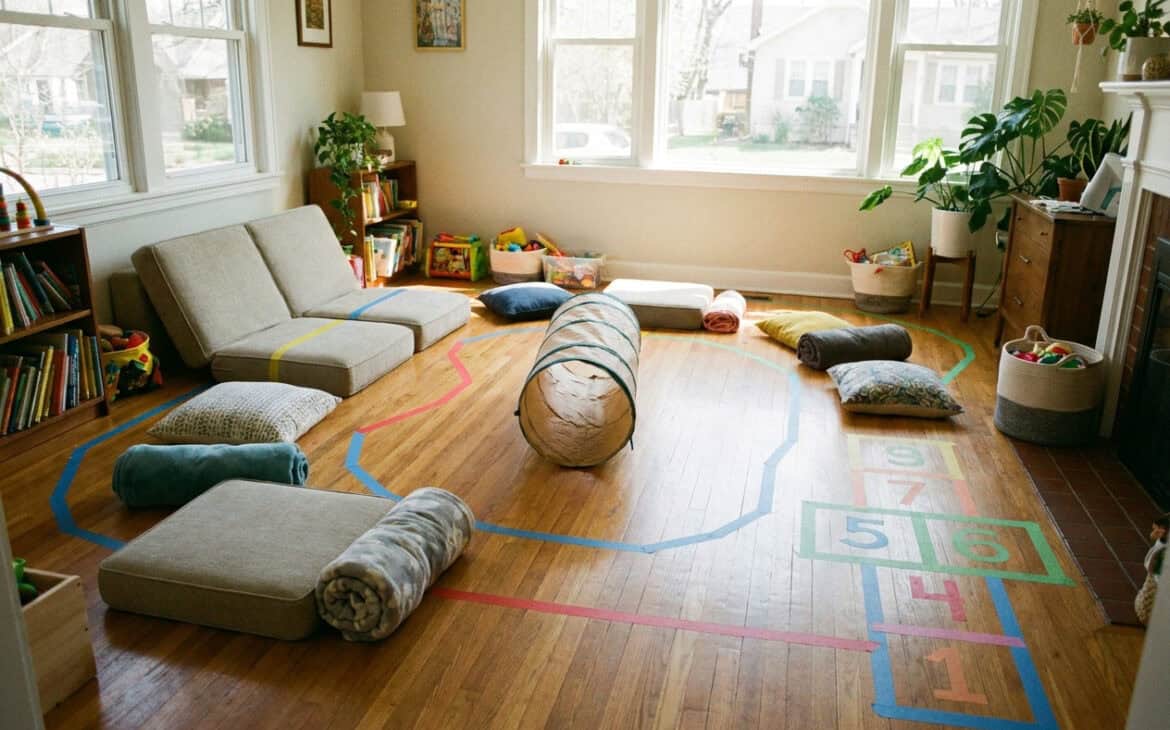
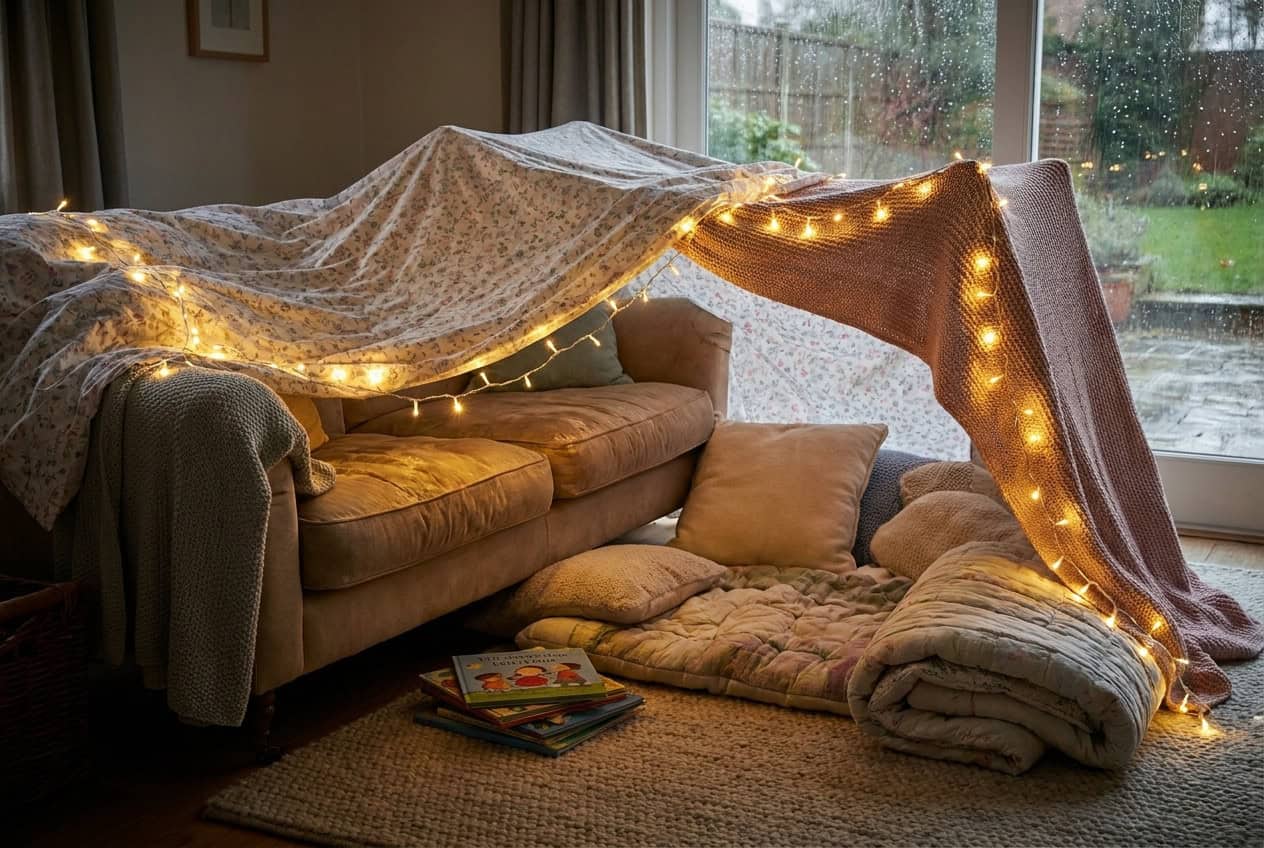
The open-ended stuff is what actually fills an afternoon, because the kids run it, not you. A blanket-and-couch-cushion fort is the undisputed rainy-day classic, and it keeps paying out: once it’s built it becomes a reading nook, a cave, a spaceship, a campsite. Lean into that with an “indoor campout” — add flashlights, a pretend campfire, and snacks eaten on the floor and you’ve turned a gray afternoon into an event.
Pretend play scales beautifully. Set up a restaurant or store where the kids take orders, make paper menus, and handle pretend money — it sneaks in early math and writing without anyone noticing. A puppet show, with sock or paper-bag puppets and the back of the couch as a stage, can absorb an hour of preparation and a two-minute performance, which is a trade every parent will take. A dress-up box of old clothes and scarves does the same work for toddlers on up.
Kitchen-table science and making things
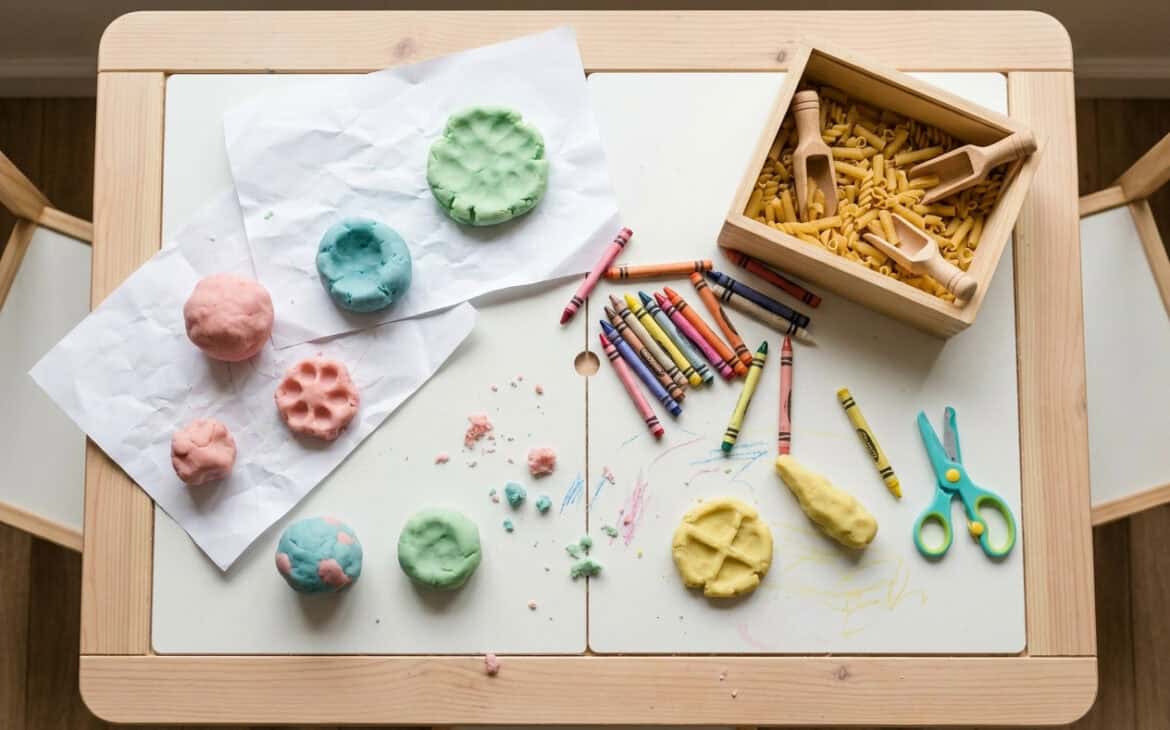
If your kids are the type who want to do something, the kitchen is a laboratory. The baking-soda-and-vinegar volcano never gets old — do it in a tray or the sink, add a squirt of dish soap and a drop of food coloring, and let them make it erupt again and again. “Sink or float,” where they predict which objects will float in a bowl of water before testing each one, works for kids as young as toddlers and teaches real cause and effect. Older kids like mixing food coloring to discover how the primary colors combine.
Baking together is a rainy-day twofer: it’s an activity and it’s dinner-adjacent, and measuring and counting are built right in. On the craft side, you can make playdough from pantry staples (flour, salt, water, oil, and cream of tartar, cooked briefly) or salt-dough ornaments you bake until hard. Paper-plate crafts, collages cut from old magazines, homemade cards for a grandparent, and paper-airplane distance contests all run on things already in a junk drawer.
The quiet hour
Every rainy day has a stretch — usually mid-to-late afternoon — where the goal shifts from entertaining to decompressing before everyone unravels. This is the moment for the calm activities. A sensory bin (a tub of dry rice, beans, or pasta with some cups and scoops) is mesmerizing for toddlers and preschoolers, though it’s worth supervising little ones with the small fillers. Sticker books, a serious coloring session with a fun prompt (“draw your dream treehouse”), or a cozy reading nook paired with an audiobook can reset the whole mood. For older kids, a big jigsaw puzzle left out on the table to chip away at over a rainy stretch gives them something low-key to drift back to.
The no-supplies classics
When you’ve got truly nothing, the old games still work. Hide and seek, I-Spy, twenty questions, Simon Says, and charades need exactly zero materials and a toddler can play simplified versions of most of them. A scavenger hunt costs one piece of paper — either hidden clues that lead to the next, or a “find these ten things around the house” list. And the standby board and card games — Go Fish, a matching/memory game, Uno, dominoes — are rainy-day royalty for a reason.
A few tricks that make it easier
The parents who handle rainy days best usually aren’t more creative — they have a couple of systems. A boredom-buster jar is the big one: write activities on slips of paper or popsicle sticks, drop them in a jar, and when “I’m bored” strikes, the kid draws one. It takes you out of the role of cruise director and adds a little randomness that makes the same old activities feel like a game.
A rainy-day bin works on the same principle. Keep a tub of things that only come out when you’re stuck inside — a fresh coloring book, playdough, a puzzle, some craft scraps — because novelty is what holds attention, and a toy you haven’t seen in three weeks is basically a new toy. Beyond that, pace the day: alternate a wiggle-burner with something calm so the kids don’t wind themselves into overtired hysterics, and save the quietest options for late afternoon. Then let them lead. A little boredom isn’t a problem to fix — it’s usually the runway for the imaginative, self-directed play you actually want.
Frequently Asked Questions
What works for toddlers versus older kids?
Toddlers need simple, supervised, sensory and movement play — sensory bins, sock fights, sorting games, animal walks, and fort time. School-age kids want challenge and independence, so lean into scavenger hunts with written clues, board and card games, building projects, science experiments, and contests like the longest paper-airplane flight. Many activities flex to fit: a balloon game is “keep it off the floor” for a three-year-old and a points-based rally for a nine-year-old.
What can I do with literally no supplies?
Plenty. Freeze dance, animal-walk relays, I-Spy, twenty questions, hide and seek, Simon Says, charades, an indoor scavenger hunt, and fort-building all run on things you already have or nothing at all.
We’re in a small apartment. What works without much space or noise?
Favor low-impact options: sensory bins, sticker books, board and card games, drawing, fort-building, puppet shows, baking, and quiet pretend play like running a “store.” For movement that won’t bother downstairs neighbors, slow balloon volleyball, charades, and animal stretches beat anything that involves jumping.
How do I keep the mess under control?
Pick contained activities on the worst days — sock fights, balloons, stickers, an audiobook with a puzzle — and corral messy science or art on a tray, in the sink, or on a wipeable surface. Lay down an old sheet before playdough or painting, and make cleanup part of the game by racing a timer.
Why bother going screen-free — isn’t a little TV easier?
A little screen time isn’t the enemy; the goal is keeping it from crowding out movement, imagination, and real interaction. As a rough guide, the American Academy of Pediatrics suggests avoiding screens other than video chat before about 18 months and limiting children ages two to five to roughly an hour a day of high-quality content, ideally watched together. Screen-free play simply does more for kids on a long indoor day — and it tends to leave them calmer than the iPad does.
My kid says “I’m bored” five minutes in. How do I make activities last?
Reach for open-ended, kid-led setups — forts, a costume box, a sensory bin, blank paper — that don’t have a built-in finish line. When interest flags, change one variable rather than the whole activity: a new obstacle-course layout, a new rule for the balloon game. And let a little boredom sit. It’s often the thing that pushes kids into inventing their own play.