Back-to-School Routines & Organization That Actually Stick

Every August, the back-to-school organizing posts promise a color-coded command center worthy of a magazine, and every September those systems quietly collapse by week two. The problem usually isn’t you, and it isn’t willpower — it’s that the routine was built to look good rather than to survive a real Tuesday. Routines that actually stick share a different DNA: they give every item a home, they front-load the chaos into the night before, and they’re simple enough that a tired family keeps doing them. Here’s how to build that, and just as important, why the perfect-looking ones fail.
Why routines fall apart — and what “stick” really takes
Most back-to-school systems die for predictable reasons: they try to change too much at once, they rely on memory instead of a visible cue, they’re imposed on kids who had no say, and they’re abandoned the first time a day goes sideways. The fix is to expect imperfection. There’s a popular myth that a habit forms in 21 days; the actual research on habit formation found it takes a median of about 66 days, ranging widely from 18 to well over 200, and — crucially — that missing a single day didn’t derail the process. So the goal isn’t a flawless streak. It’s a lower baseline of chaos and a system resilient enough to survive an off morning. Pediatric groups like the American Academy of Pediatrics make the case for routines plainly: kids do best when daily life is regular, predictable, and consistent, because knowing what comes next gives them a sense of control. That security is the payoff — not a spotless mudroom.
Give everything a home: the launch pad and the paper pile
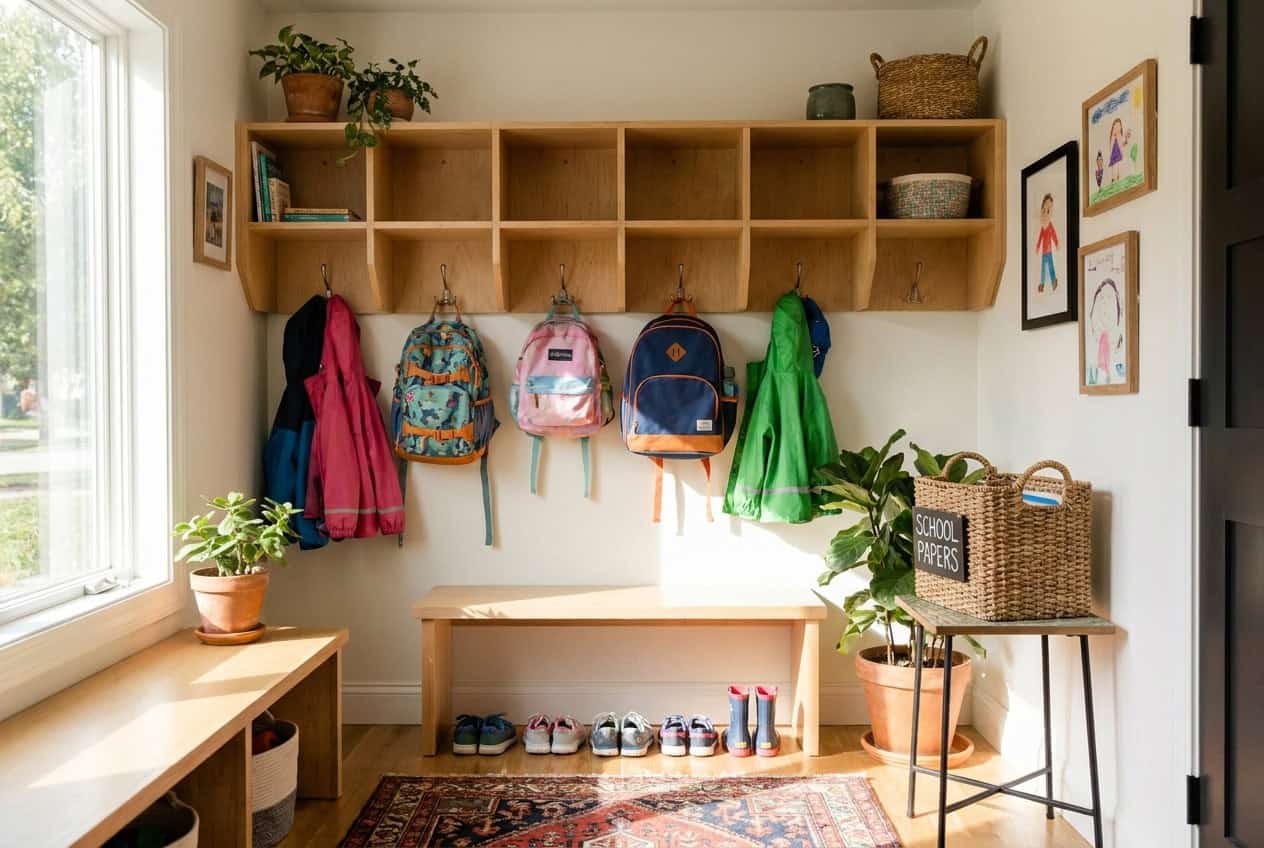
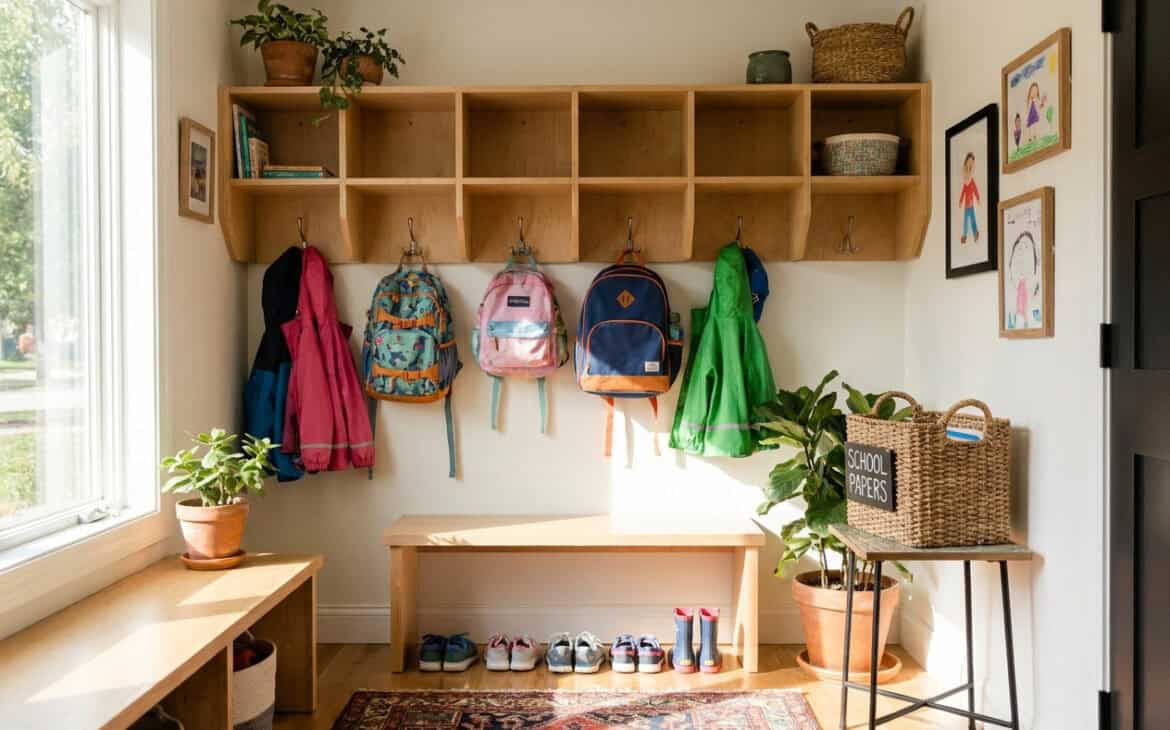
Half the morning scramble is a hunt for objects, so the highest-leverage fix is a launch pad by the door where every kid has one labeled bin (color-coded for the pre-readers) and a hook at their height — if they can’t reach it, the backpack lives on the floor. Put it where the pileup already happens rather than where you wish it would, because fighting existing traffic patterns guarantees the system gets abandoned. Add one separate “papers for grown-ups” bin right there to intercept time-sensitive forms before they vanish into a backpack.
The paper avalanche deserves its own rule: handle each piece once. As papers come in, sort them on the spot into recycle, action (sign, RSVP, money due), and keep, with a pen and recycle bin stationed at the launch pad. Time-sensitive items go in an action file so deadlines don’t get buried. For the flood of artwork, a simple loop works — display it on a clipped wire or a rotating gallery, photograph the favorites to keep them forever, and recycle the originals without guilt, saving only a small keepsake box per child. The memory is preserved; the volume isn’t.
Win the morning the night before
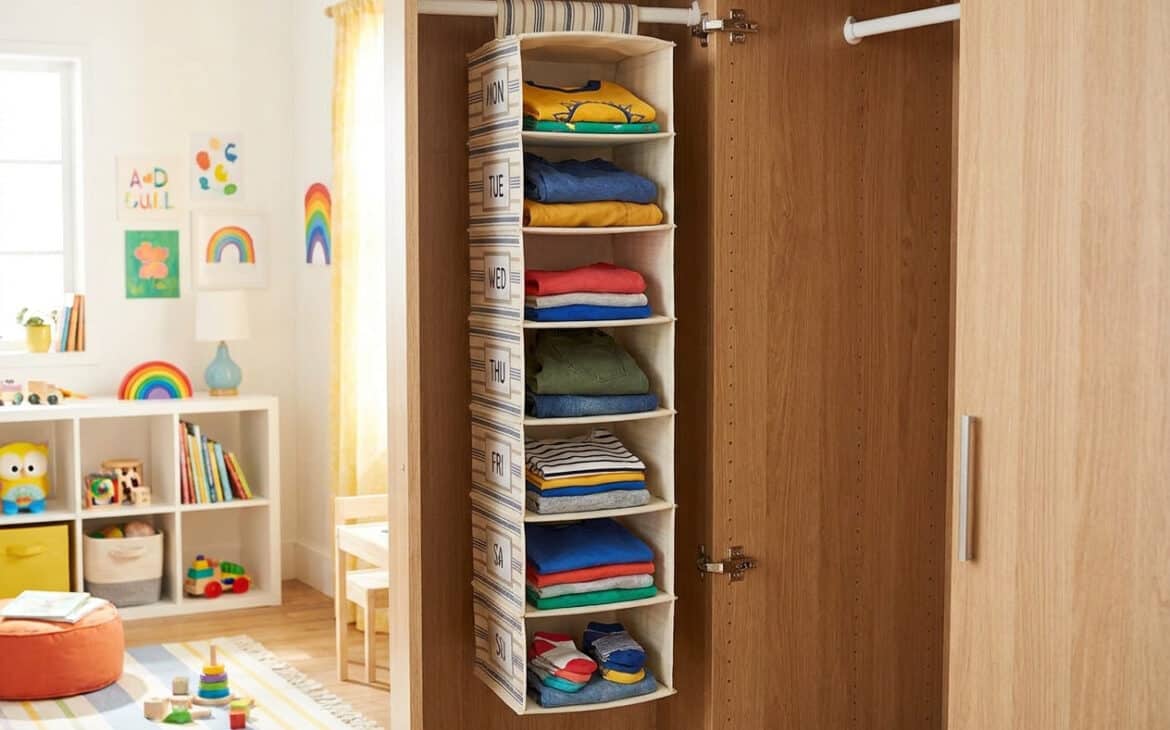
Nearly every calm morning is actually built the evening before. Clothes laid out head to toe (socks and shoes included), backpacks packed and parked at the launch pad, lunches prepped, and breakfast decided — do all of it under no time pressure at night, and the morning becomes assembly rather than invention. A hanging day-of-week closet organizer, with a full outfit chosen for each weekday (with the kid, against the week’s forecast), eliminates the single most common morning standoff: what to wear. Stacked, labeled drawer bins do the same job if you’d rather not hang anything.
Homework, meals, and a calendar everyone can see
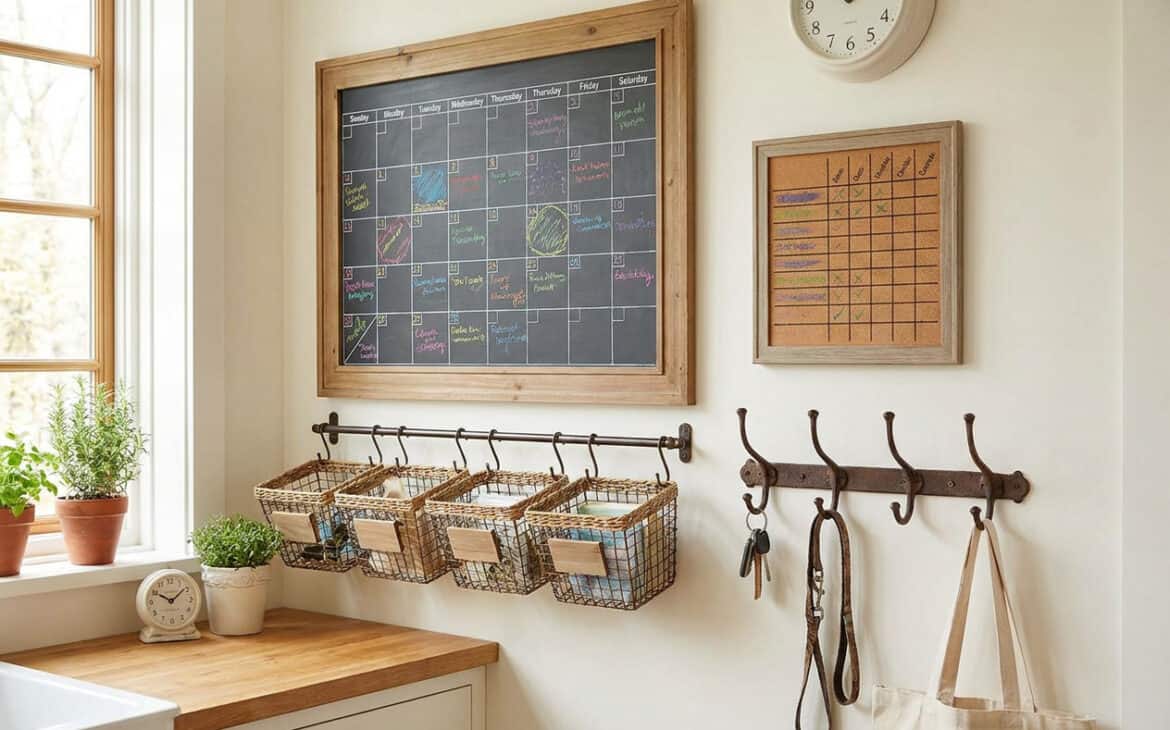
After school runs smoother with a predictable sequence — snack, a break, homework, then repack the backpack and set it by the door — and a portable supply caddy that turns any table into a homework station, so nobody loses ten minutes hunting for a glue stick. Let the kid choose when homework happens within reason; the bit of agency noticeably improves cooperation. Anchor it all to one large shared calendar in the kitchen, color-coded by person, as the family’s single source of truth — it kills the double-booking and the “nobody told me” that derail a week.
Meals are the other recurring pressure point, and they’re far easier with a system than with nightly improvisation. A dedicated lunch-packing station — one drawer with all the gear and a bin of grab-and-go components — turns packing into an assembly line; our lunchbox ideas give you the rotation to fill it. And a weekend batch of make-ahead breakfasts takes the most rushed meal of the day off your plate entirely.
Let kids own their routines
A routine the kids helped build is one they’ll actually follow, because the ownership is the point. For younger children, a picture-based routine chart (dress, eat, teeth, shoes, bag) offloads the nagging onto the chart — kids under about eight can’t reliably hold a multi-step sequence in their heads, and a visual lets them self-direct. Let them set the order of the cards; choosing makes it “mine.” Hand over age-appropriate responsibility too: the AAP notes that five-to-seven-year-olds can make their bed, set and clear the table, and start packing their own lunch; eight-to-ten-year-olds can vacuum and help with dinner; and eleven-and-twelves can run the dishwasher, do laundry, and cook a simple supervised meal. Introduce one task at a time, anchor it to the existing rhythm of the day, and praise the effort, not just the result.
Making it stick: start small, and start early
Begin a week or two before school, not on the first morning, so the routine is partly automatic by day one — and shift sleep gradually, about fifteen minutes earlier every two or three days, rather than all at once. Start with one small change rather than overhauling everything; the most reliable way to cement a new habit is to anchor it to one you already have (“after we brush teeth, we pack the backpack”), so the existing routine becomes the cue and you’re not relying on willpower. Keep it consistent and in the same place, expect it to take a couple of months rather than a couple of weeks to feel automatic, and when it drifts — because it will — review it with the kids, simplify to a few essential steps, and reset. That willingness to adjust is what separates the routines that stick from the ones that end up in the recycling with September’s worksheets.
Frequently Asked Questions
When should we start back-to-school routines?
About one to two weeks before school starts. Shift sleep and wake times gradually — roughly fifteen minutes earlier every two or three days — until you reach the target, since abrupt changes leave kids short on sleep and unfocused. Starting early means the routine is partly built before day one.
How do I get my kids to actually follow the routine?
Build it with them, so they own it, and use a visual chart for younger kids — a picture checklist they can follow without you repeating yourself, and one that’s harder to argue with than a parent. Keep the steps developmentally realistic (just a few for little ones), stay consistent, and let them help set the order.
How can I make mornings less chaotic?
Move as much as possible to the night before — lay out clothes, pack bags and lunches, decide breakfast — and set it all at a launch pad by the door. A visual checklist and a timer let the clock do the nagging instead of you. The mornings that run smoothly are almost always the ones set up the evening before.
How do I organize all the school papers and forms?
Run one command center and handle each paper once as it arrives: sort into recycle, action (sign and return), and keep, with a pen and recycle bin right there. File time-sensitive items separately so they don’t get buried, keep a small keepsake box per child, and photograph artwork to preserve it digitally before recycling the originals.
What if the routine stops working after a few weeks?
That’s normal and expected, not a failure. Usually the routine got too complicated, life changed, or the kids never fully owned it. Review and adjust it regularly, involve the kids in troubleshooting, simplify to three to five essential steps, and reset with fresh tools — post it where it’s actually used and add a timer.
How long until a new routine feels automatic?
Longer than the “21 days” myth suggests. Research on habit formation found it takes a median of about 66 days, with a wide range, and that missing one day doesn’t ruin it. Expect a couple of months of consistency, not a couple of weeks, and don’t abandon ship over an off day.