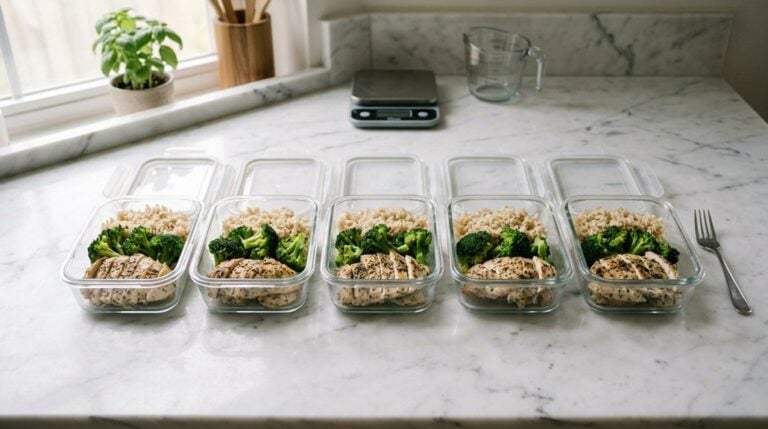
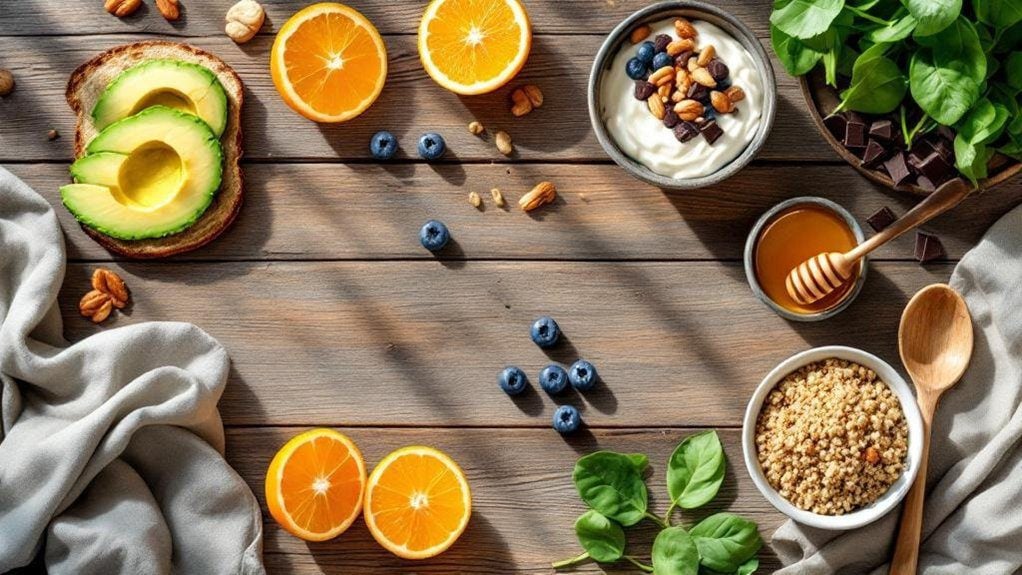
Fresh fruit and healthy breakfast ingredients on wooden table, promoting wellness and nutritious living.

Ditch the Coffee—Try These Natural Foods That Power You Through the Day

Coffee addicts, listen up. Bananas deliver potassium for quick fuel, berries fight inflammation, and leafy greens pack iron that battles fatigue. Eggs and lean meats provide lasting energy, while avocados serve up healthy fats without the crash. Quinoa offers complete proteins. Even plain water beats dehydration-induced exhaustion. These foods work together—no jitters, no dependency, just steady energy. The science behind why these alternatives crush coffee’s monopoly might surprise even the most devoted caffeine fans.

natural foods boost energy

Energy crashes hit hard. That afternoon slump makes everyone reach for another cup of coffee, but the body might respond better to actual food. Shocking concept, really.

Bananas work like nature’s energy bars. They deliver potassium for muscle function and provide quick, lasting fuel without the jittery aftermath. Leafy greens pack iron that fights fatigue—spinach and kale aren’t just rabbit food anymore.

Berries bring antioxidants that reduce inflammation while elevating energy levels. Blueberries, strawberries, blackberries—take your pick. They all work. Goji berries protect cells from free radical damage while mixing perfectly into morning oatmeal.

Sweet potatoes and yams release energy slowly through complex carbohydrates and fiber. No sugar spike, no crash. Just steady fuel. Whole grains like oats do the same thing, digesting slower than processed alternatives. They keep blood sugar stable, which means the brain and body don’t quit halfway through the day.

Unprocessed versions contain more vitamins, minerals, and fiber. Processing strips the good stuff out. Quinoa and brown rice offer complete proteins alongside their complex carbohydrates.

Protein plays the long game. Eggs, lean meats, fish, beans, and legumes all contribute to sustained energy. The body burns more calories digesting protein, maintaining steady energy and keeping hunger at bay.

SEE ALSO  Why Your Perfect Sleep Routine is Ruining Your Night's Sleep (And What Actually Works)

Yogurt combines protein, fats, and simple carbs—an efficient fuel mixture. Plant-based options like beans and lentils deliver protein plus iron. Nuts and seeds add healthy fats, protein, and fiber to the mix. Pumpkin seeds, chia seeds, flaxseeds—they’re tiny powerhouses.

Water matters more than most people think. Dehydration causes fatigue faster than anything else. Coconut water replaces electrolytes lost through sweat. Herbal teas like peppermint and ginger offer mild energy increases without caffeine.

Speaking of ginger, animal studies show it amplifies energy expenditure and mitochondrial function. It might increase thermogenesis and brown adipose tissue activity. Human studies remain inconclusive, but the potential exists.

Healthy fats from avocados, olive oil, and fatty fish provide sustained energy while helping absorb vitamins A, D, E, and K. They nourish brain function, protect organs, and slow digestion for balanced blood sugar.

Fat isn’t the enemy—it’s fuel that lasts.

Coffee has its place, but real food delivers energy without the inevitable crash. The body knows what to do with whole foods. It’s been practicing for millennia.

Similar Posts

  • Bust Those Bad Habits: The Neuroscience-Backed Method That Actually Works (Not Another 21-Day Myth)

    It is often the case that people who swear a lot will impose a swear jar on themselves. So every time that they say an offensive word or a banned word from home, they will need to put money in the jar. You can implement the same idea with your own bad habits.
    It is better that you have someone to hold you accountable; for example, if you are trying to kick smoking as your bad habit tells your friends and family that if they see you light up, or you smell of cigarette smoke that you owe them a dinner. Or perhaps you want to up the ante slightly, and you must give them $5.
    Triggers
    We will often repeat bad habits without realizing that we are doing them, but there are usually triggers that lead up to that bad habit. For example, if you are trying to cut back on alcohol, it might be that you need an alcohol detox center to help set you on the right path.
    Being able to identify what your triggers are will massively help you in the road to kicking, you have it to the curb. If it’s stress-related, then you might need to find some new outlets for when this happens. Replace bad habits with good ones; when you are stressed, take the time to make a fresh orange juice or a smoothie rather than go for a glass of wine.
    Slowly
    Bad habits are built up over time, and good habits or two. If you try to change too many habits at once, you are setting yourself up to fail. Instead, work on one thing at a time and take it slowly. You have time to break your bad habit, and you must celebrate the small wins too.

  • Why Your 3-Year-Old Will Master Potty Training in 9 Days (While Your Neighbor’s 18-Month-Old Takes 12 Weeks)

    This is a sponsored post on behalf of Charmin Ultra Soft at Sams Club and Acorn Influence. All thoughts are 100% my own.
    If there is one thing I’ve done a few times it’s potty training…It’s never easy and ALWAYS different from child to child…but there are 2 major things you need to have an easier time potty training: Lots of patience and LOTS of Charmin toilet paper. I have successfully potty trained three of my own kids, and I can’t even count how many from working in child care…and now I’m in the beginning stages of potty training my baby boy. Even with all this “experience” I’m by no means an expert at potty training but I do know a thing of two about potty training success. Along the way I have learned that with positive reinforcement, patience, lots of Charmin, and a few distractions…your child will go from diapers to potty in no time!
    HOW TO KNOW IF (S)HE’S READY?
    Many parents don’t start potty training until their children are 2 1/2 to 3 years old, when daytime bladder control has become more reliable. And some children aren’t interested in potty training until they’re closer to 3, or even 4.
    My boys were all around 3 when they were potty trained, my 6-year-old pretty much potty trained himself at 3…after trying and trying and no progress, one day he came in from outside to go potty…and never went in his diaper again…if only they were all so easy!
    Signs they may be ready
    Urinates a fair amount at one time.
    Has regular, well-formed bowel movements at relatively predictable times.
    Has “dry” periods of at least two hours which shows that bladder muscles are developed enough to hold urine.
    Can pull his pants up and down.
    Dislikes the feeling of wearing a wet or dirty diaper.
    Shows interest in others’ bathroom habits (wants to watch you go to the bathroom or wear underwear).
    Gives a physical or verbal sign when he’s having a bowel movement such as grunting, squatting, or telling you.
    Demonstrates a desire for independence.
    Takes pride in his accomplishments.
    Isn’t resistant to learning to use the toilet.
    Can follow simple instructions, such as “go get the toy.”
    EASY POTTY TRAINING TIPS
    Once your child shows signs of potty training readiness, use these simple tips for potty training success!
    Create a potty schedule. Try and go every hour or hour 1/2 to start out. Make sure you continue this even if you are out.
    Provide a space for them. Now this isn’t always possible, but even a basket with books, training pants/underwear next to their potty makes the space more inviting and less “cold” to a toddler.
    Provide LOTS of Charmin. you will go through a lot of Charmin. Kids love to wipe even if they don’t go, I’ve had melt downs when I try to tell them they don’t need to wipe..so just let them do it and have plenty on hand.
    Provide lots of encouragement! Kids love to know they are doing something exciting and that pleases you…let them know!
    Provide a distraction. Give them books to read…or mine likes to watch his favorite cartoons on the tablet sometimes. This gets them to sit longer and eventually “go”.
    Provide positive reinforcement. I like to use natural, healthy fruit snacks rather than a “sweet treat”. He gets a few after each time he goes, and then when the he seems to be getting the hang of the potty I can slowly start to ease back on the positive reinforcements. You could even try new undies as a positive reinforcement. They could pick out a new pair to wear if they go all day..etc.
    STICK WITH IT! Don’t give up, if your child is showing the signs they will need your encouragement even through their setbacks to get through and to the happy place.
    You know the saying “patience is a virtue”…you will really need it during potty training time, there WILL be setback days, tantrums, refusal and accidents but just remember that it is okay! You don’t want to show your frustration it will discourage them and set them back further. Using disposable pull-ups are helpful and transition to using both pull-ups and undies once you both get in the swing of the potty training thing. Once you start potty training do not give up! As dory says…Just keep swimming!
    1,000 EXTRA SHEETS VALUE!
    Having a family of 6 means that I regularly shop at Sams Club for my families daily needs. Starting in mid-November, Sam’s Club will be re-introducing Charmin Ultra Soft back into the club for a limited time! That has me excited as Charmin Ultra Soft is my favorite go-to toilet paper! Plus Charmin Ultra Soft is celebrating the value of getting more for their families by offering a thousand more sheets per package! That’s a huge value for us potty training parents!
    How about a giveaway?
    To be entered to win, you must share your potty training tip/trick and the hashtag #CharminatSamsClub on Twitter or Instagram. Prizes are 53 $50 Sam’s Club gift cards. Good Luck!
    $50 Sam’s Club Gift Card Giveaway for Charmin
    Disclosure of Material Connection: This is a “sponsored post.” The company who sponsored it compensated me via a cash payment, gift, or something else of value to write it. Regardless, I only recommend products or services I use personally and believe will be good for my readers. I am disclosing this in accordance with the Federal Trade Commission’s 16 CFR, Part 255: “Guides Concerning the Use of Endorsements and Testimonials in Advertising.”

  • The Science-Backed Secret to Achieve Your Fitness Goals: Why 15-Minute Workouts Beat 2-Hour Gym Sessions

    Fitness is a subjective thing. What one person may believe define as fitness, another person may disagree with. It is crucial to think about what fitness means to you so that you know what you want to achieve. For some people, looking fit means building muscle using products such as muscle rage to increase their muscle mass, for others, their idea of fitness is achieving a toned, flexible body through activities such as yoga.
    Clarifying in your mind precisely what you want to achieve and what being fit means for you will help you to determine how your goals can be reached.
    Setting Your Fitness Goals
    To achieve a goal, you firstly need to decide exactly what those goals are. Many people begin their fitness journey with a vague idea in mind of what they want to achieve, but no clear way of knowing when they have achieved this goal. It is tough to keep working towards a goal if it is not clearly defined in the first place. To overcome this uncertainty and to enable you to stay focused, it is useful to put together some SMART goals.
    You are probably used to hearing the term SMART goals spoken about in business terms, but SMART goals are essential for achieving your fitness goals too. Applying the SMART principle to setting fitness goals will enable you to clarify exactly what you want to achieve and how you are going to make that happen. Set your fitness goals on the basis that they are Specific, Measurable, Attainable, Relative, and Timely. This means that you know exactly what you want to achieve (Specific). Will be able to monitor what you have achieved (Measurable). Ensure achieving your goals is possible (Attainable). Choose activities that will help you reach your goals (Relative). Have a time-scale for your achievements (Timely).
    Making your goals realistic, but still challenging enough to help you reach the result that you want is essential.

  • Why Your Back Still Hurts (And the Breathing Fix Everyone’s Missing)

    Look at how you sleep
    The position you sleep in could affect how your back feels. If you sleep in a way that aggravates your back, it could end up more painful. If you sleep on your side, you might want to try sleeping with a pillow between your knees to reduce strain on your back. If you prefer to sleep on your back, try sleeping with a pillow under your knees.
    It is also vital to ensure that you are sleeping on a good quality mattress. An old, damaged mattress can cause your back pain to get worse.
    Keep it moving
    It might be tempting to rest your back for long periods when it is painful, but you should try to keep it moving. Continue to do all of your everyday tasks as best as you can, and when you are able, you might want to try and do some light exercises. Over resting can result in the muscles in your back getting weaker, and your back pain getting worse.
    Think about your posture
    Sitting in a weird position with your back hunched over is going to do nothing for your back pain. Try to sit upright with your shoulders back and relaxed. If you work in an office, or anywhere else that requires you to sit for long periods, make sure that your chair supports your back correctly, and that you don’t slump over your work.
    Take painkillers
    Over-the-counter painkillers and anti-inflammatory drugs will be able to help you deal with your back pain. It will take the edge off and make it easier for you to keep moving. If over-the-counter painkillers don’t ease the pain, you should visit your doctor.