Simply Straight Brush Review: Does It Actually Work?

The Simply Straight brush is the As-Seen-On-TV ceramic straightening brush that promises sleek hair without the flatten-and-fry feel of a flat iron. I’ve used it and dug into how heated straightening brushes actually behave on different hair, and the honest verdict is more interesting than either the infomercial or the one-star reviews would have you believe. Here’s what it does well, where it genuinely struggles, how to get the most out of it, and whether it’s the right tool for your hair.

What it actually is
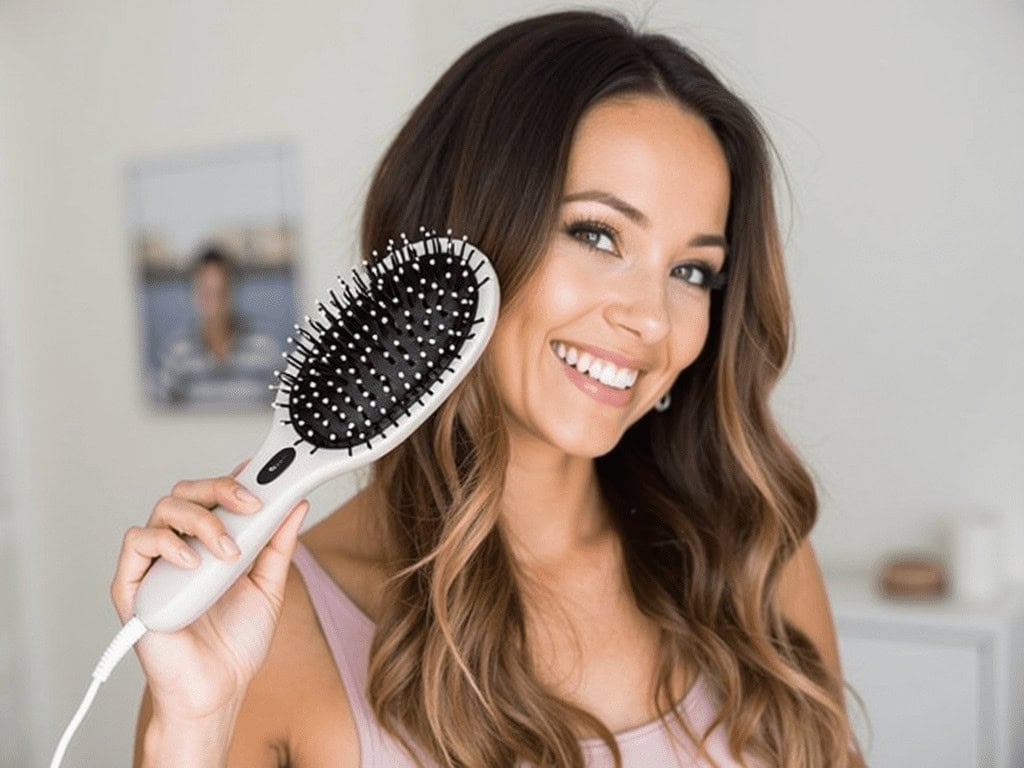
Picture a normal paddle brush with a ceramic heating element baked into the bristles. Instead of pressing a section of hair between two hot plates the way a flat iron does, the heated bristles glide through your hair as you brush. The teeth separate your strands and warm them from all sides while the brush shape keeps a little lift at the root, which is exactly why a brush leaves you smooth but still bouncy rather than pin-straight and pressed.
The ceramic part matters more than it sounds. Ceramic holds a steady, even temperature, so you get fewer scorching hot spots than the cheap metal tools that fry one patch while leaving another untouched. The Simply Straight reaches about 350°F in roughly a minute and tops out at 450°F, which is hotter than most hair will ever need.
How a straightening brush works on your hair
All heat styling does the same basic thing: it temporarily breaks the weak hydrogen bonds that hold your hair’s natural shape, then lets them re-form straight as the hair cools. That single fact explains the two rules you can’t break. Your hair has to be bone dry first, because the water trapped in damp hair turns to steam under heat and wrecks the cuticle. And you have to move slowly, because the bonds only release if the section actually reaches temperature on the pass. Rush, and they snap right back into a wave. The upside of a brush is that it smooths the cuticle instead of compressing it, so you get the frizz control and shine without the hard crease an iron can leave behind.
Does it actually work?
Honestly, it depends almost entirely on your hair, and the gap between hair types is wider than the box admits. If yours is fine to medium and wavy, this is the brush’s sweet spot. Two slow passes get you smooth, straight-with-body hair that genuinely rivals a flat iron, and because fine hair straightens at lower temperatures, you can keep the heat down and the damage minimal. Thick or long hair gets there too; it just asks for patience, smaller sections, and the occasional second pass.
The honest letdown is coarse, very curly, or tightly textured hair. More than one person with that texture ends up with softened waves rather than truly straight strands, and notices the brush is slow to recover its heat between sections. If your hair already shrugs off a regular flat iron, this brush won’t be the thing that finally beats it, though it still works nicely as a fast first pass before you touch up the stubborn roots with an iron. Across user reviews, that’s the pattern: praise for how gentle and snag-free it is, frustration when people with coarse hair expected glass-straight results.
What to expect the first time
Give yourself more time than you think for the first go, because the first session is really about learning the right pace. After the minute or so of heat-up, someone with fine, short hair might finish in five to ten minutes, while thick hair past the shoulders can easily take twenty to thirty. As for how long it lasts: straight results hold beautifully on a dry day and start creeping back toward your natural texture the moment humidity climbs, since those hydrogen bonds happily reabsorb moisture from the air. A finishing serum or anti-humidity spray buys you hours.
How it compares to a flat iron

The quick version is that a brush is the safer, faster everyday tool, while a flat iron still wins for a glass-smooth finish and for taming truly resistant hair. A flat iron’s plates press strands flat with concentrated, direct heat, which is what gives you that sleek, almost-wet look and the power to straighten coarse hair, but it’s also easier to overdo and it takes practice to use well. The Simply Straight, by contrast, is basically foolproof: if you can brush your hair, you can use it, and you’re far less likely to crease or singe a section. Plenty of people keep both and reach for the brush on ordinary mornings.
One number worth keeping in mind is heat. Start around 300–340°F for fine or damaged hair, 320–360°F for medium, and only push toward 360–400°F for thick or coarse textures. That 450°F maximum is best avoided entirely on fine or color-treated hair, where it just accelerates damage and fading for no real benefit.
How to use it
The technique is simple, but the order matters:
- Start with clean, fully dry, detangled hair, and never force the brush through a knot.
- Apply a heat protectant and let it dry completely before you turn the brush on.
- Set the temperature for your hair type and let it fully heat.
- Clip your hair into one-to-two-inch sections; smaller sections beat dragging through a thick chunk every time.
- Brush slowly from root to tip in one continuous motion, lightly guiding the section taut with your free hand.
- Do a second pass only if a section needs it, then finish with a lightweight serum or anti-humidity spray.
When it goes wrong (and how to fix it)
Most complaints trace back to two or three fixable habits. If your hair stays wavy, you’re almost always moving too fast or working with sections that are too thick, so slow down and split them smaller. If the brush seems to lose its heat partway through, give it a couple of seconds to recover between sections, especially on thick hair. Frizz or a dried-out feel afterward usually means the temperature was too high or you skipped the heat protectant. And if it snags, the culprit is hair that wasn’t fully detangled before you started, not the brush itself.
Who should buy it, and who shouldn’t
If you have fine-to-medium, wavy-to-mildly-curly hair and you want fast, low-effort smoothing with less heat damage and a softer finish than a flat iron, the Simply Straight is an easy recommendation, especially at its low As-Seen-On-TV price. If your hair is very thick, coarse, or tightly coiled and you’re after a sleek, long-holding result, you’ll be happier with a quality flat iron, or using the brush only to soften before you touch up with one.
The verdict
For the right hair type, the Simply Straight brush quietly punches above its price: smooth, touchable, voluminous hair in minutes, almost no learning curve, and meaningfully less stress on your strands than clamping plates. Just buy it for what it is, a smoothing-and-de-frizzing tool first and a full straightener second, and it earns its spot in the drawer.
Frequently Asked Questions
Is the Simply Straight brush bad for your hair?
It’s gentler than a flat iron because it doesn’t clamp your strands, but it’s still a heated tool. Use it on dry hair, with a heat protectant, at the lowest temperature that works, and it’s a low-risk way to style. Use it on damp hair or cranked to 450°F and it can damage hair like any hot tool.
Can you use it on wet hair?
No. Only clean, fully dry hair. Heat plus the moisture in damp hair creates steam that swells the cuticle and leads to frizz, split ends, and breakage.
How long does it take to heat up?
About a minute to reach 350°F, with a 450°F maximum. Some people find it slower than a flat iron to recover heat between sections, which matters most on thick hair.
Does it work on curly hair?
It smooths loose curls and waves well. Very tight or coarse curls may only soften into waves and can need a higher setting, a second pass, or a flat iron to get fully straight.
How is it different from a blow-dry brush?
A blow-dry brush uses airflow to dry and style damp hair. The Simply Straight is a dry-hair tool you use after your hair is already dry, smoothing and straightening with direct contact heat.
How do I make the results last longer?
Finish with a lightweight anti-humidity serum or spray, avoid re-wetting or constantly touching your hair, and accept that on humid days some natural texture will return as your hair pulls moisture from the air.
Related Reading
- Guitar Hero Live in 2024: The Complete Guide to Playing After GHTV (Yes, It Still Works)
- 11 Comfortable, Stylish Spring Shoes That Won’t Hurt Your Feet
- Tommie Copper Sock Review
- BONKAZONKS Marvel Game -Review/Giveaway-