
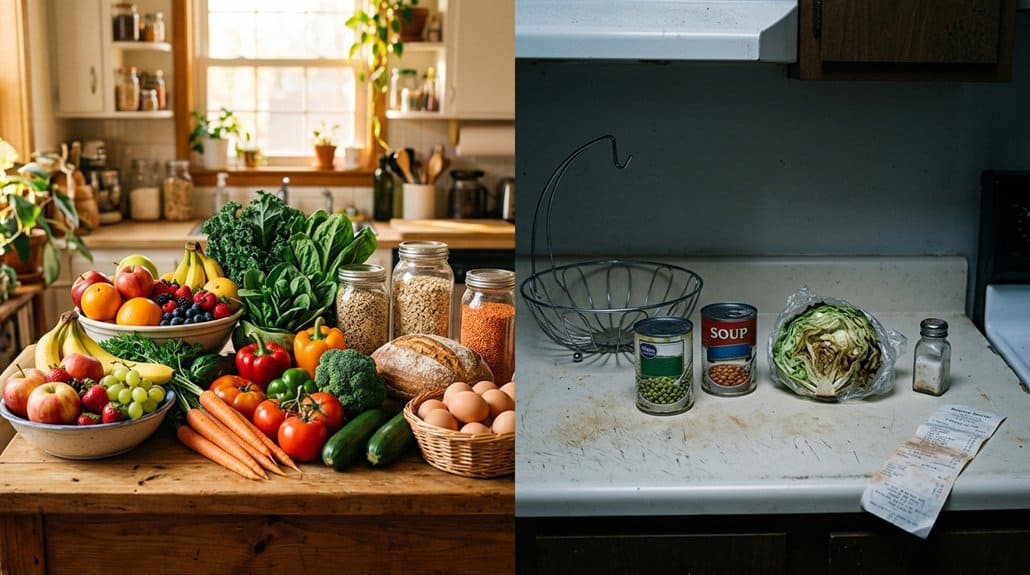
New Report: The Devastating Divide Between States With Best and Worst Healthy Food Access

A new report shows 53.6 million Americans — roughly 17.4% of the population — live in low-income areas with lousy access to healthy food. The Southeast gets hit hardest. In North Carolina’s Halifax County, residents drive an average of 22 minutes just to reach a grocery store. Meanwhile, Wilson County has 74% of its food retailers selling fresh produce. Same state, wildly different realities. The divide between communities only gets more alarming from there.
While the term “food desert” might sound like some dramatic geographical feature, it’s really just a polite way of saying millions of Americans live nowhere near a decent grocery store. According to USDA data, 53.6 million people — 17.4% of the U.S. population — live in low-income census tracts with low access to healthy food retail. That’s not a rounding error. That’s a crisis.
53.6 million Americans can’t easily reach a grocery store. That’s not a statistic — it’s a national failure.
The Southeast gets hit hardest. States like North Carolina, Mississippi, and Arkansas carry a disproportionate concentration of food deserts, and the public health fallout is brutal. Obesity rates climb. Options shrink. In Halifax County, North Carolina, residents average 22 minutes just to reach a grocery store. In Edgecombe County, only 20% of food retail locations sell fresh produce. Compare that to neighboring Wilson County, where 74% do. Same state. Wildly different realities.
Race and income make the gap worse. Higher-poverty, chiefly Black neighborhoods consistently show reduced access to healthy food compared to higher-income white areas. Northampton, Halifax, and Edgecombe counties have the widest stretch of Black residents living beyond half a mile from a supermarket in the entire state. These same counties also have the highest concentration of Black agricultural producers. They grow food but can’t easily buy it. Let that sink in.
Some states are trying to respond. Mississippi’s Senate Bill 2077 funds nonprofits that match SNAP dollars spent on fruits and vegetables at farmers markets. Arkansas passed Senate Bill 59, reimbursing school breakfasts at $1.90 each with a $14.7 million commitment for 2025-2026. Tennessee created a task force specifically aimed at ending childhood hunger.
Meanwhile, food policy councils — 283 of them active across nearly every state — are pushing municipal-level change. Municipalities with these councils report a 92.3% rate of having at least one healthy food access policy on the books. Critics also argue that the overemphasis on supermarket proximity as a fix obscures deeper causes, since current policies incentivizing store development in designated food deserts have shown little success in improving health disparities or actual food security.
Still, the national food insecurity rate sat at 14.3% in 2023. Policies exist. Programs exist. But the divide between states doing something and states doing nothing remains enormous. Low access means being more than half a mile from a supermarket in urban areas, or 10 miles in rural ones. For millions, that distance isn’t just inconvenient. It’s dangerous.


