
Best Stroller Wagons of 2026: Top Picks & Buying Guide

This post contains affiliate links.
Somewhere between “my toddler refuses to walk another step” and “how do I carry two kids, a diaper bag, and the beach gear at once,” most parents discover the stroller wagon, and then wonder how they ever managed without one. It’s part stroller, part wagon, and all hauling capacity, and it’s become the go-to for zoo days, festivals, the beach, and busy neighborhoods. But they range from about a hundred dollars to well over seven hundred, and the differences genuinely matter. Here’s how to choose the right one, plus the models worth your money in 2026.
Stroller Wagon vs. Regular Stroller: When a Wagon Wins
A traditional stroller is still the better tool for quick errands, jogging, or navigating a crowded store aisle, it’s lighter, narrower, and folds in a second. Where the wagon pulls ahead is capacity and longevity. Where a stroller seats one or two kids facing forward with a small basket underneath, a wagon gives you a big open bay that fits two children side by side along with the cooler, the towels, the toys, and the inevitable rock collection. It also tends to last longer through the years, because kids who’d refuse a “baby” stroller will happily pile into a wagon, and many models seat up to four. If your outings are long, gear-heavy, and over varied ground, a wagon earns its space in the garage.
What to Look for in a Stroller Wagon
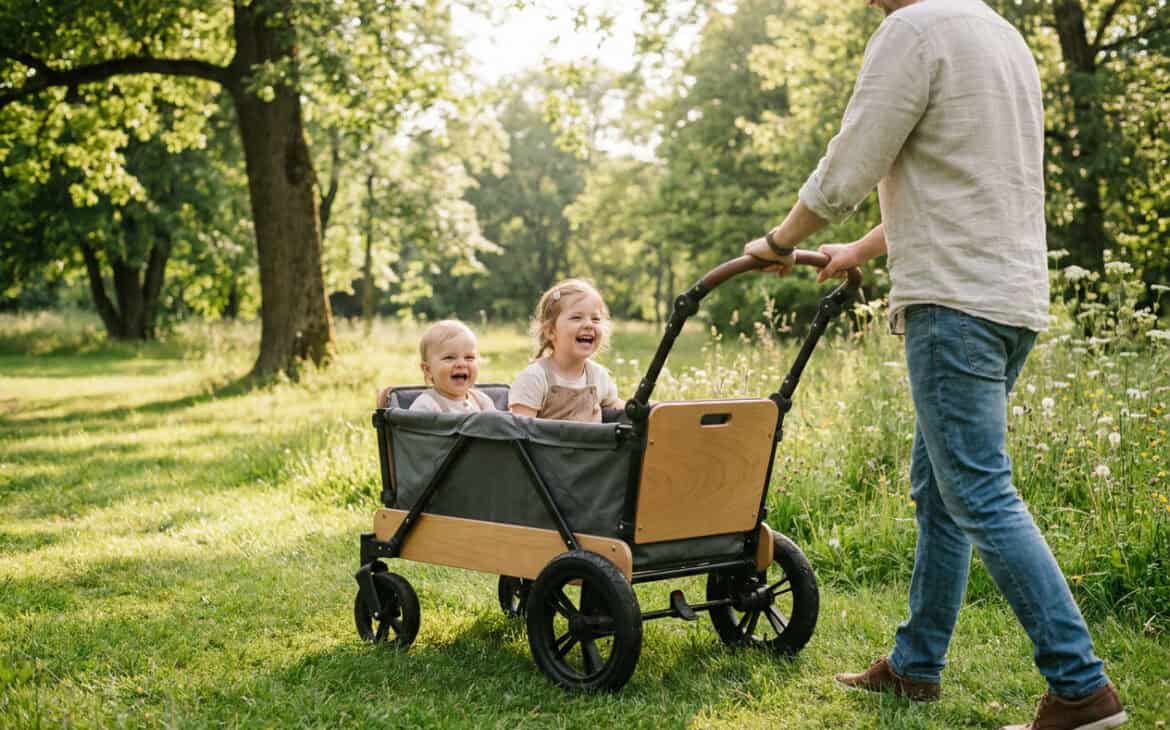
Push or pull (or both). This is the first real decision. Push-style wagons steer like a stroller and are easier on your back and shoulders over long distances, while pull-style models are lighter to maneuver into tight spots but harder on your arm. The most flexible wagons convert between both, which is genuinely useful when you go from a packed festival path to an open boardwalk.
Seating and weight limits. Decide up front how many kids you’re hauling, then read the manual rather than guessing, capacity and the total weight limit (often around 100 to 110 pounds for a two-seater) are safety specs, not suggestions. Look for padded seats, real five-point harnesses for each child, and high sides.
Wheels and terrain. If you’ll stick to sidewalks and smooth paths, standard wheels are fine. For grass, gravel, sand, or trails, you want large all-terrain wheels, ideally air-filled or rubberized, paired with a suspension system and a sturdy frame, which together are the difference between a smooth glide and a fight the whole way.
Storage, shade, and folding. Beyond the kid bay, look for cup holders, parent and child pockets, and an under-bay basket, the little conveniences you’ll use constantly. A UPF canopy is close to essential for sunny days. And check the folded dimensions against your trunk before you buy; a wagon that won’t fit in your car is a wagon you’ll leave at home.
Stability. Because wagons sit higher and carry more, tipping on a sharp turn is the main safety concern. A wide wheelbase, a low center of gravity, and quality brakes all help, and it’s worth testing maneuverability in person if you can, to feel whether it stays planted when you corner.

The Best Stroller Wagons of 2026
Wonderfold W4 / Anthem (Best Overall)
Wonderfold is the brand that made stroller wagons mainstream, and its lineup remains the one to beat. The four-seat models are roomy, the turning radius is genuinely tight for something this size, and the thoughtful extras, multiple cup holders, kid-friendly pockets, a removable UPF canopy, and a one-pull fold, are why it tops so many lists. It’s a premium buy, but for a big family that will use it for years, it’s the most complete option.
Veer Cruiser (Premium Pick)
The Veer Cruiser is the rugged, do-everything luxury option, built like an outdoor gear piece with all-terrain capability and a deep ecosystem of accessories (infant seats, snack trays, weather covers) you can add as your needs change. It’s an investment, but if you hike, hit the beach often, or just want the sturdiest ride available, it’s the one enthusiasts keep recommending.
Jeep Sport All-Terrain (Best Value)
If the premium prices give you sticker shock, the Jeep Sport All-Terrain is the smart middle ground, a well-rounded wagon with all-terrain wheels at a noticeably friendlier price. It won’t have every bell and whistle of the luxury models, but it covers the essentials, capacity, terrain capability, and storage, for families who want a capable wagon without the top-tier spend.
Evenflo Pivot Xplore (Most Versatile)
The Pivot Xplore’s trick is that it converts between a push stroller mode and a pull wagon mode, so you get two tools in one as your situation changes from a tight store to an open park. It’s durable, reasonably priced, and a great fit for parents who can’t decide between push and pull, because they don’t have to.
Keenz (Best for Events & Budget)
Keenz wagons are a fixture at festivals, fairs, and theme parks for good reason: they’re affordable, pack in tons of storage, and come with a big canopy for all-day sun. They lean toward pull-style use and aren’t quite as refined as the premium models, but for occasional big outings on a budget, they deliver a lot of wagon for the money.
Push vs. Pull, and Single vs. Double
If you’re still torn, think about your most common outing. For long days and lots of walking, a push-style (or convertible) wagon will save your back, while pure pull wagons shine for shorter trips and tight, crowded spaces. On size, resist the urge to oversize “just in case”, a four-seater is wonderful for a big family but heavy and bulky for a single child, where a compact two-seater is easier to fold, store, and steer. Buy for the family you have now, with maybe a little room to grow.
Using a Stroller Wagon Safely
Whatever you choose, a few habits keep it safe: buckle every child into their harness every time, stay within the stated weight and age limits, set the brake whenever you stop (especially on any slope), and slow down through turns to avoid tipping. Distribute heavy gear low and centered rather than piled on one end, and keep little hands away from the wheels and folding joints.
Frequently Asked Questions
Are stroller wagons better than strollers?
Not better, different. Wagons win on capacity, gear storage, and seating multiple kids for long, varied outings, while traditional strollers are lighter, narrower, and better for quick trips, jogging, and tight stores. Many families eventually own both.
What age is a stroller wagon for?
Most are designed for toddlers and older (often around one year and up when seated with a harness), though some accept infant car seats or bassinet attachments. Always follow the specific model’s age and weight guidance.
Push or pull, which is better?
Push is easier on your back over long distances and steers more like a stroller; pull is lighter for tight spaces. Convertible models like the Evenflo Pivot Xplore let you do both.
How many kids can ride in a stroller wagon?
Typically two to four depending on the model, within a total weight limit that’s usually around 100 to 110 pounds for a two-seater. Check your specific wagon’s manual.
Can you use a stroller wagon on the beach or trails?
Yes, if it has large all-terrain wheels and good suspension. Models like the Veer Cruiser and Jeep All-Terrain handle sand, grass, and gravel far better than basic sidewalk wheels.
Related Reading
- Bridal Shower Ideas: How to Throw One People Actually Enjoy
- Health Benefits of a Nomadic Lifestyle (and the Honest Trade-offs)
- Tommie Copper Sock Review
- BONKAZONKS Marvel Game -Review/Giveaway-